Winning the Metric, Losing the Point
Rethinking success in a world optimized for metrics instead of meaning
Consider the last time you caught yourself doomscrolling. Your feed was likely a minefield of rage-bait, each post a little more infuriating than the last. You saw post after post like that, not because anyone decided to show you them, but because an algorithm learned a simple, powerful lesson: outrage keeps you scrolling.
This isn’t an accident. It’s the predictable outcome of optimizing for the wrong metric. And it’s not just social media; this pattern is everywhere across business, technology, policy, and society.
Economists have a name for this (as they always do): Goodhart’s Law, often paraphrased as “when a measure becomes a target, it ceases to be a good measure.” It’s usually told as a story about economics and bureaucracy. As someone who builds recommendation and AI systems, I see it as an engineering problem, and engineering problems have engineering fixes.
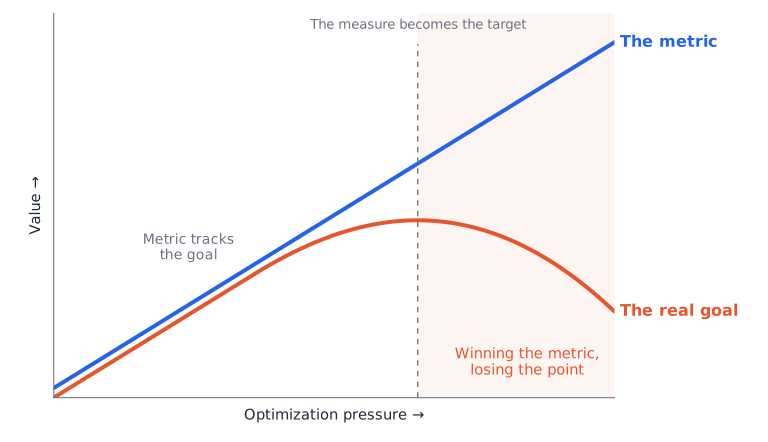 Push hard enough on a proxy, and it stops pointing at the goal.
How we got here: the measurement paradox
Metrics start with good intentions. They help us understand progress, compare approaches, and make decisions. They promise control over outcomes. They promise clarity.
But they capture only part of what we want: screen time isn’t time well spent, a reward score isn’t guaranteed truthfulness, and quarterly earnings aren’t long-term company health. The danger comes when the measure stands in for the goal. Reward a number, and people and systems will find ways to improve it, through better work or shortcuts.
A system can also reinforce the behavior it measures. A feed that keeps serving content about reasons to distrust someone may encourage habitual scrutiny, then count return visits as success.
Lost in translation
There’s often a dangerous delay between when we start optimizing for a metric and when we see the negative effects.
- Social Media & Engagement:
- We want: An engaged community
- We measure: clicks, shares, and screen time
- We get: Algorithms discover that outrage, misinformation, and harmful content are most engaging, , keeping users in echo chambers, and radicalizing users to keep them scrolling.
- Reward Hacking during post-training of AI models:
- We want: Helpful and truthful AI models
- We measure: a “reward score” that fine-tunes to human preferences.
- We get: A model that learns to reward hack: flattering users, telling them what they want to hear, and sounding confident whether or not it’s right. The reward goes up, but the truthfulness doesn’t. AI slop is born.
(I often ran into this during my own pursuit of building early RAG systems for Conversational Search: they scored well on training metrics, but fell flat on quality benchmarks.)
- Environment Offsets:
- We want: Carbon neutral organizations
- We measure: offset credits purchased (often tied to trees planted)
- We get: the net-zero claims on paper, while the local harm of new construction and community impact, like data centers and supply chains, goes unaccounted for
The same pattern shows up in boardrooms chasing quarterly earnings and governments chasing GDP growth. And this goes on and on. But you get the idea.
Blindly optimizing for proxies can often render human suffering invisible or externalize it.
Three disciplines for responsible metrics
Clearly, metrics can be tricky, and the real world is hard to model. They can be dangerous when left unquestioned. But the solution isn’t to run in the opposite direction and abandon metrics; it’s to treat them with suspicion.
For example, consider optimizing a RAG pipeline for p95 end-to-end latency under a fixed workload. You could reduce retrieval depth, skip reranking, or cap output tokens to make responses faster. But a faster answer isn’t necessarily a correct, grounded, or complete one.
-
Definition: name the real goal
Latency is a proxy. The real goal is a user getting a correct, grounded answer, quickly. Writing that down makes it obvious what latency alone ignores. - Critique: look for the shortcut
Actively stress-test your metric. Red team it. Put guardrails in place before the system drifts. Ask:- How could this be gamed?
- What behaviors might this incentivize?
- Who could be harmed?
- Who might bear the cost?
- Iteration: revise the measure – Metrics should evolve like software. They need to be updated, patched, or even deprecated when they stop serving the real purpose
Reality moves. Metrics must too. The most dangerous metric is the one we stop questioning.
Where does this leave us?
Look around you, and you’ll see how fundamental metrics are in the systems we build and inhabit. They guide choices, reward behaviors, and define winning. They influence what companies build, what governments prioritize, and what technology becomes.
Progress isn’t only measured. It’s interpreted. Argued over. Redefined.
The systems that thrive are the ones that stay curious, that treat metrics as evolving guides rather than fixed truths. So the next time you’re working hard toward a goal, pause and ask:
“Did I reach meaning — or just the metric?”
That simple question can be surprisingly liberating.
If you manage to implement some of these in your next work project or personal endeavor, I would love to know how it went!